



📅 Wednesday 29th April 2026 | 🕐 13:00–14:00
🔗 Click here to join the meeting on MS Teams
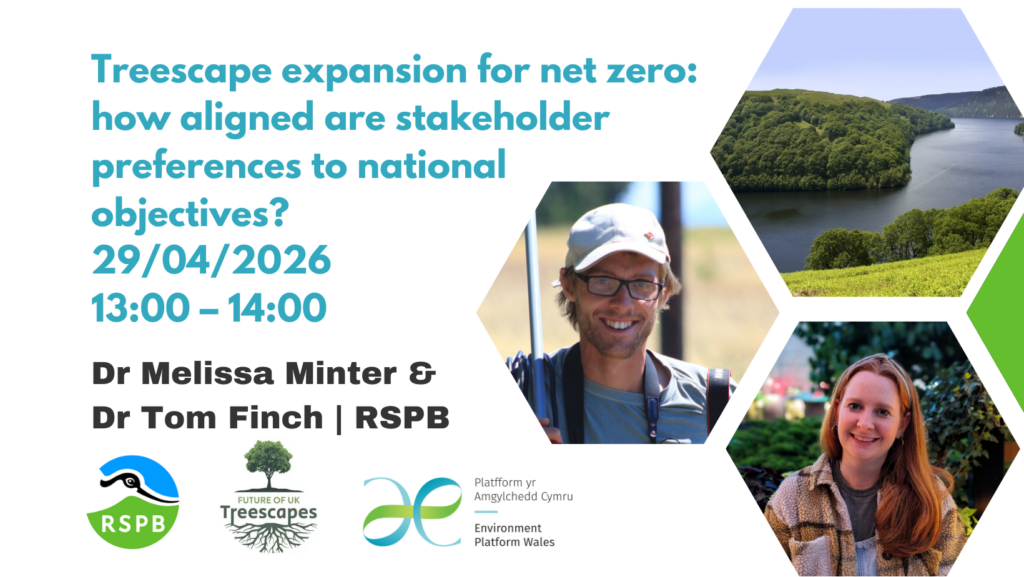
Woodlands and trees sequester carbon, and so can contribute to reaching net zero greenhouse gas emissions. Top-down scenario modelling can be used to estimate how much additional tree cover might be needed to meet targets such as net zero, and how these changes might be distributed across individual landscapes given variation in biophysical and policy constraints. Such exercises rarely consider the views of local stakeholders, who will be most directly impacted by land-use change, and who may be charged with delivering it. In two upland landscapes in northern England and mid Wales we find broad alignment between bottom-up and top-down objectives for future tree cover, though stakeholders have diverse views, with some preferring increases in tree cover which are lower than required to meet national net zero objectives. Reconciling these differences is challenging, but participatory approaches are essential to ensure that different interests are respected and heard.
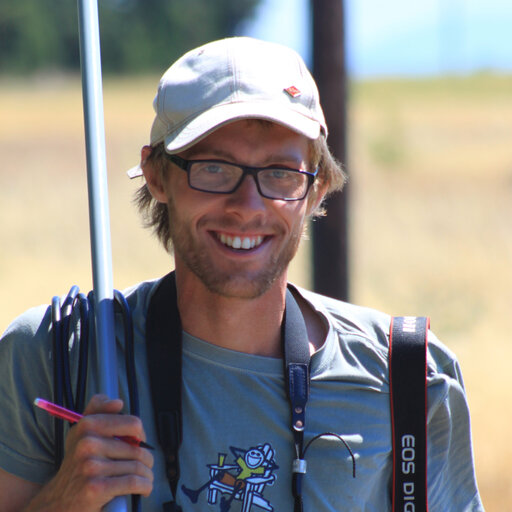
Dr Tom Finch is RSPB’s Principal Conservation Scientist for Sustainable Land Use. He has a background in ecological modelling, and expertise in land use scenario modelling. He holds a PhD from the University of East Anglia on the conservation ecology of the European Roller, and leads the STAND project.

Dr Melissa Minter is Lead Carbon Data Analyst at RSPB, and worked as lead Conservation Scientist on the STAND project. She holds a PhD from the University of York on the climate ecology of montane butterflies, and has an interest in upland ecology.