



Joining Instructions: Join the meeting on MS Teams | Meeting ID: 321 300 428 853 4 | Passcode: q75gi6cL
View Recording: With the speakers permission, we will share the presentation recording on our website at: Insights Wales / Cipolwg Cymru – 2026-27 Recordings – epwales.org.uk
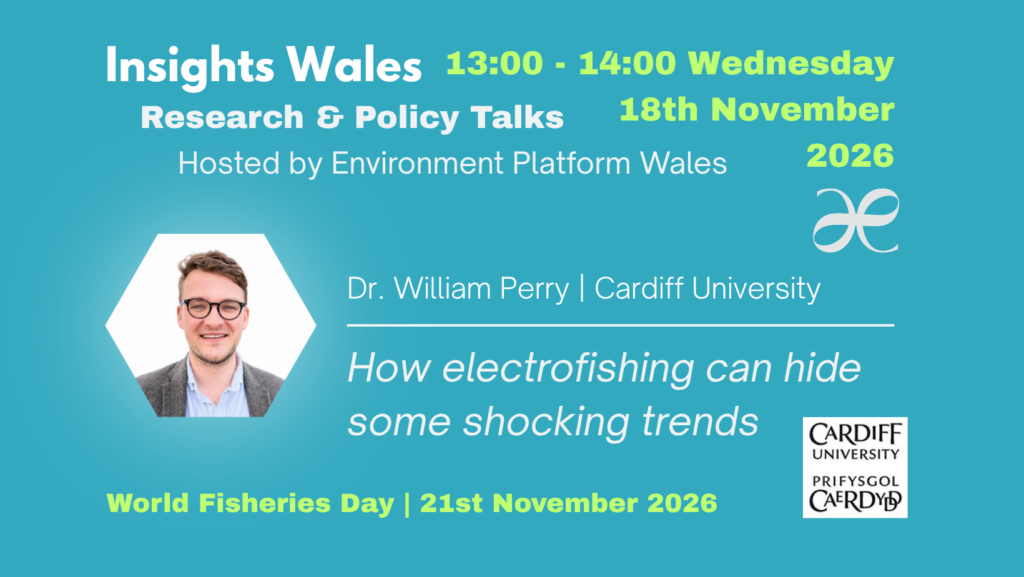
Electrofishing is often relied on as the gold standard for freshwater fish monitoring, telling us what species are present in a stretch of water and their abundance. Its ability to easily enumerate freshwater fish is a benefit that gives it the edge on other monitoring techniques like eDNA. To do this effectively, multiple passes using the electrofishing gear are conducted in the same area. In each subsequent catch the number of fish should decline as the population is depleted, which is assessed through depletion models. However, in order to save time and money, single-pass electrofishing surveys are being used, but when left uncalibrated these surveys can provide misleading trends. Here, using national electrofishing surveys from Wales (Natural Resources Wales) and England (Environment Agency), we explore how capture probability in electrofishing surveys differ between species, as well as potential drivers of varying capture probabilities (including traits of the fish as well as hydrological conditions) and the impact this could have on long-term abundance trends of key freshwater fish species.
About the Speaker

Dr William Perry is a Postdoctoral Research Associate at Cardiff University, with a background in molecular ecology. His focus has become increasingly data orientated with the utilization of a broad array of analytical approaches to understand how freshwater ecosystems are responding to anthropogenic pressures, in terms of their ecology and evolution. The use of aqueous environmental DNA and high throughput sequencing for biodiversity monitoring is of particular interest, due to this technique’s powerful ability to produce unprecedented amounts of data on biological communities.Whilst he has worked with many biological systems, including viruses, bacteria, invertebrates and plants, much of his research has focused on fish., leading to his appointment as a Senior Editor for the Journal of Fish Biology, as well as Publicity Coordinator for the Fisheries Society of the British Isles (FSBI).